
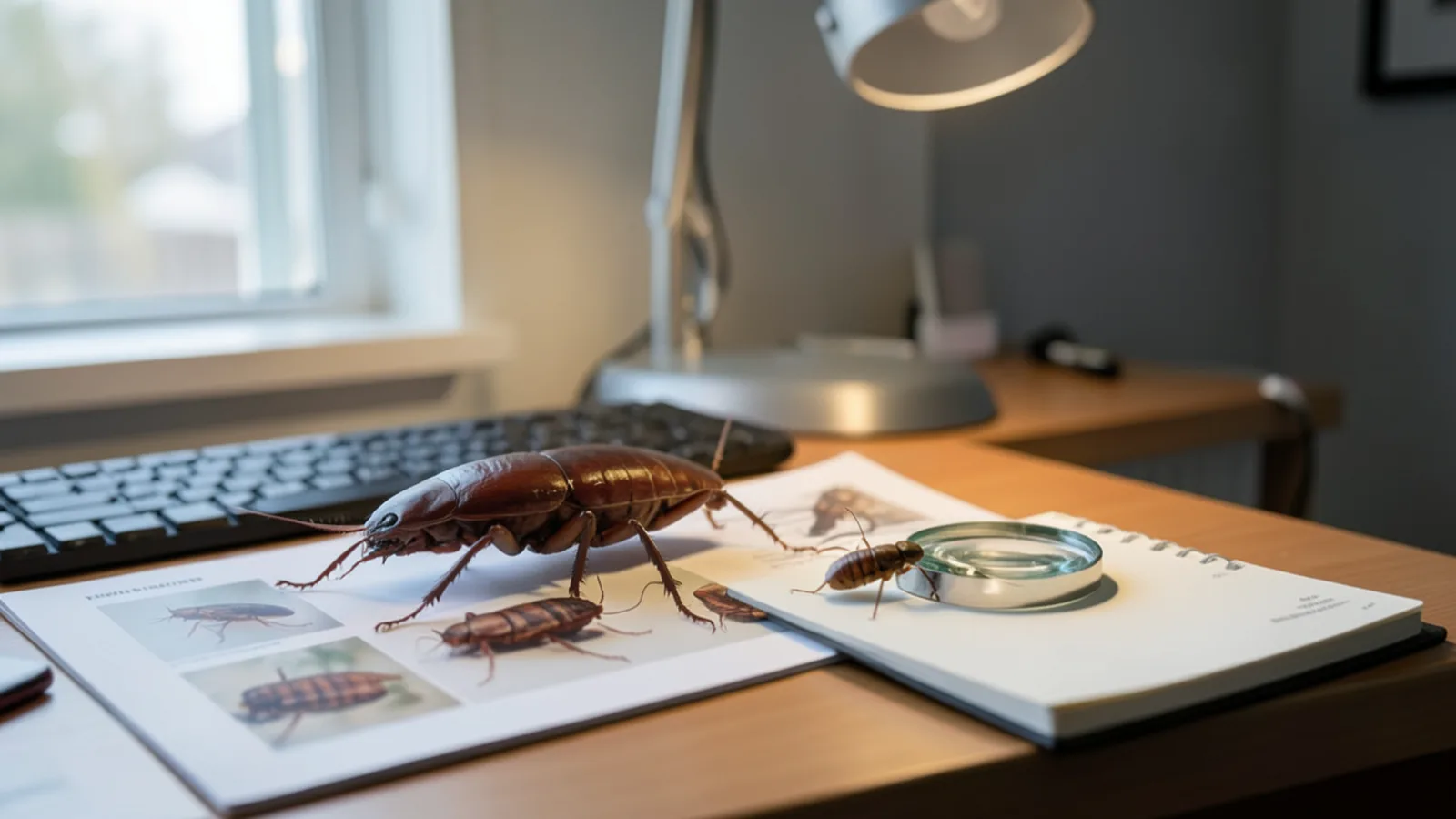
Palmetto bugs (American cockroaches) are large (1.5–2 inches), reddish-brown outdoor insects that live in mulch and palms, occasionally wandering indoors after rain. German cockroaches are small (1/2 inch), light tan with two dark back stripes, and live exclusively indoors in kitchens and bathrooms, multiplying exponentially. Palmetto bugs require exterior perimeter sealing, while German roaches require an intensive multi-week bait and clean-out program. Call (321) 496-4080 for expert roach extermination.
- 01.Visual Comparison: Size, Markings, and Behavior Differences
- 02.Why Palmetto Bugs Invade Ruskin Homes After Summer Rains
- 03.The German Cockroach Threat: Rapid Reproduction and Health Risks
- 04.Contrasting Treatment Strategies: Exterior Sealing vs Interior Precision Baiting
- 05.Florida Contractor Insight: Why Aerosol Sprays Make German Roaches Worse
- 06.How Clean Homes Contract German Cockroaches in Florida
Visual Comparison: Size, Markings, and Behavior Differences
Confusing a palmetto bug with a German cockroach is easy for new Florida residents, but the two pests represent fundamentally different biological challenges requiring completely opposite remediation strategies.
Palmetto bugs (the regional colloquial term for the American cockroach, *Periplaneta americana*, and occasionally the smokybrown cockroach) are massive insects reaching 1.5 to 2 inches in length. They are glossy reddish-brown with a distinct yellow margin around the pronotum (the shield directly behind the head). Adults possess fully developed wings and can perform clumsy gliding flights toward porch lights.
German cockroaches (*Blattella germanica*), by contrast, are tiny pests measuring only about 0.5 inches (12 to 15 millimeters) in length. They are light tan or yellowish-brown, recognized instantly by two dark, parallel longitudinal stripes running down their pronotum. Although adult German roaches possess wings, they never fly; instead, they run with exceptional agility across countertops and walls.
Behavioral context provides the most crucial diagnostic clue: spotting a large palmetto bug in your living room usually means a single outdoor wanderer slipped in through an unsealed door threshold. Sighting even one small German cockroach on a kitchen counter during daytime indicates an established, hidden colony numbering in the hundreds nesting inside appliances and wall voids.
| Feature | Palmetto Bug (American Cockroach) | German Cockroach |
|---|---|---|
| Adult Size | 1.5 to 2.0 inches long | About 0.5 inches (12–15 mm) long |
| Color & Markings | Glossy reddish-brown with yellow margin behind head | Light brown/tan with 2 dark parallel stripes on back shield |
| Flight Capability | Capable of clumsy, short gliding flights toward lights | Has wings but never flies; runs rapidly across surfaces |
| Primary Natural Habitat | Outdoors in decaying mulch, palms, sewer lines, attics | Strictly indoors in kitchen cabinets, appliances, bathrooms |
| Reproductive Rate | Moderate; takes up to 12 months to reach maturity | Exponential; produces 30–40 nymphs per egg case every 3 weeks |
| Remediation Focus | Exterior exclusion, door sweeps, perimeter granular barrier | Interior non-repellent gel baiting, void dusting, IGRs |
Seeing Roaches in Your Kitchen or Bathrooms?
Connect with an independent roach exterminator specializing in precision gel baiting and exterior perimeter exclusion.
Why Palmetto Bugs Invade Ruskin Homes After Summer Rains
Palmetto bugs naturally inhabit moist, humid outdoor environments rich in decaying organic matter. In South Hillsborough communities like Ruskin, Sun City Center, and Riverview, they thrive in deep pine bark mulch beds, decomposing palm frond boots, hollow oak trees, and municipal stormwater drainage networks.
Under normal conditions, palmetto bugs prefer living outdoors where they feed on leaf litter, decaying fruit, and organic debris. However, heavy Florida summer afternoon downpours inundate mulch beds and overwhelm municipal storm drains.
To avoid drowning in saturated soils, palmetto bugs climb concrete foundation stem walls and seek dry shelter. They enter residences through worn door sweeps, gaps beneath garage doors, sliding glass door tracks, and unsealed weep holes in brick and stucco facades. Once indoors, they wander into bathtubs and sinks seeking moisture, unable to survive long in air-conditioned indoor air.
The German Cockroach Threat: Rapid Reproduction and Health Risks
German cockroaches are strictly domestic pests that cannot survive outdoors in nature. They rely 100% on human structures for warmth, food, and moisture. They harbor in tight, dark micro-crevices within five feet of food and water sources—such as refrigerator compressor motor housings, microwave clock housings, dishwasher insulation, under-sink plumbing cabinets, and drawer glide tracks.
What makes the German cockroach terrifying is its exponential reproductive potential. A single female produces an egg capsule (ootheca) containing 30 to 48 eggs every few weeks, carrying the egg case attached to her abdomen until hours before hatching. Nymphs mature into reproductive adults in as few as 36 to 60 days. In a single year, a single pregnant female can give rise to over 30,000 descendants.
Furthermore, German cockroach infestations pose severe health risks. Their cast skins, decomposing bodies, and fecal droppings contain potent allergen proteins (Bla g 1 and Bla g 2) that become airborne in household dust. Exposure to cockroach allergens is a leading cause of severe childhood asthma attacks and chronic allergic rhinitis. They also mechanically transmit dangerous foodborne pathogens, including *Salmonella*, *E. coli*, and *Staphylococcus*, across food preparation counters.
Contrasting Treatment Strategies: Exterior Sealing vs Interior Precision Baiting
Because these two roach species occupy completely different ecological niches, treating them requires fundamentally opposite strategies.
Florida Contractor Insight: Why Aerosol Sprays Make German Roaches Worse
The most destructive error a homeowner can make when encountering German cockroaches in their kitchen is purchasing cans of over-the-counter bug spray or aerosol bug bombs.
German cockroaches are naturally thigmotactic (preferring tight cracks where their bodies contact surfaces) and communicate via aggregation pheromones. When a homeowner sprays an aerosol pyrethroid into a kitchen cabinet, the harsh repellent chemicals alert the colony instantly.
While a few dozen roaches walking in the open may die, the repellent residue acts as a dispersal trigger. Surviving females carrying egg capsules scatter in panic, fleeing deep inside hollow interior drywall partitions, electrical conduit boxes, living room furniture, and adjoining bedrooms.
Within two weeks, an infestation that was neatly localized to a single kitchen cabinet expands into a whole-home catastrophe. Effective German roach eradication requires stealthy, non-repellent chemistries that the insects consume willingly and share socially through necrophagy and coprophagy, systematically collapsing the hidden population from the inside out.
How Clean Homes Contract German Cockroaches in Florida
There is a persistent social stigma that German cockroaches only infest dirty homes. In reality, clean homes are colonized just as easily because the insects are introduced via hitchhiking rather than poor sanitation.
German cockroaches commonly enter homes concealed in cardboard corrugated shipping boxes delivered from warehouses, grocery sacks, pre-owned kitchen appliances, electronics purchased second-hand, and luggage following stays in multi-unit vacation rentals.
While immaculate housekeeping deprives roaches of accessible food crumbs, a German cockroach can survive for weeks on microscopic grease films, soap residue, bookbinding glue, or toothpaste droppings. If you suspect an introduction, acting quickly with an independent professional baiting clean-out prevents population explosion.
Florida Roach Identification Questions & Answers
Palmetto bugs are poor, clumsy fliers attracted to light. When startled, they glide toward bright light sources (such as an open doorway, television, or lamp behind you), giving the mistaken impression that they are aggressively attacking.
- Cockroaches of Florida: Identification and Management — University of Florida IFAS Extension
- Cockroach Allergens and Asthma — National Institute of Environmental Health Sciences