
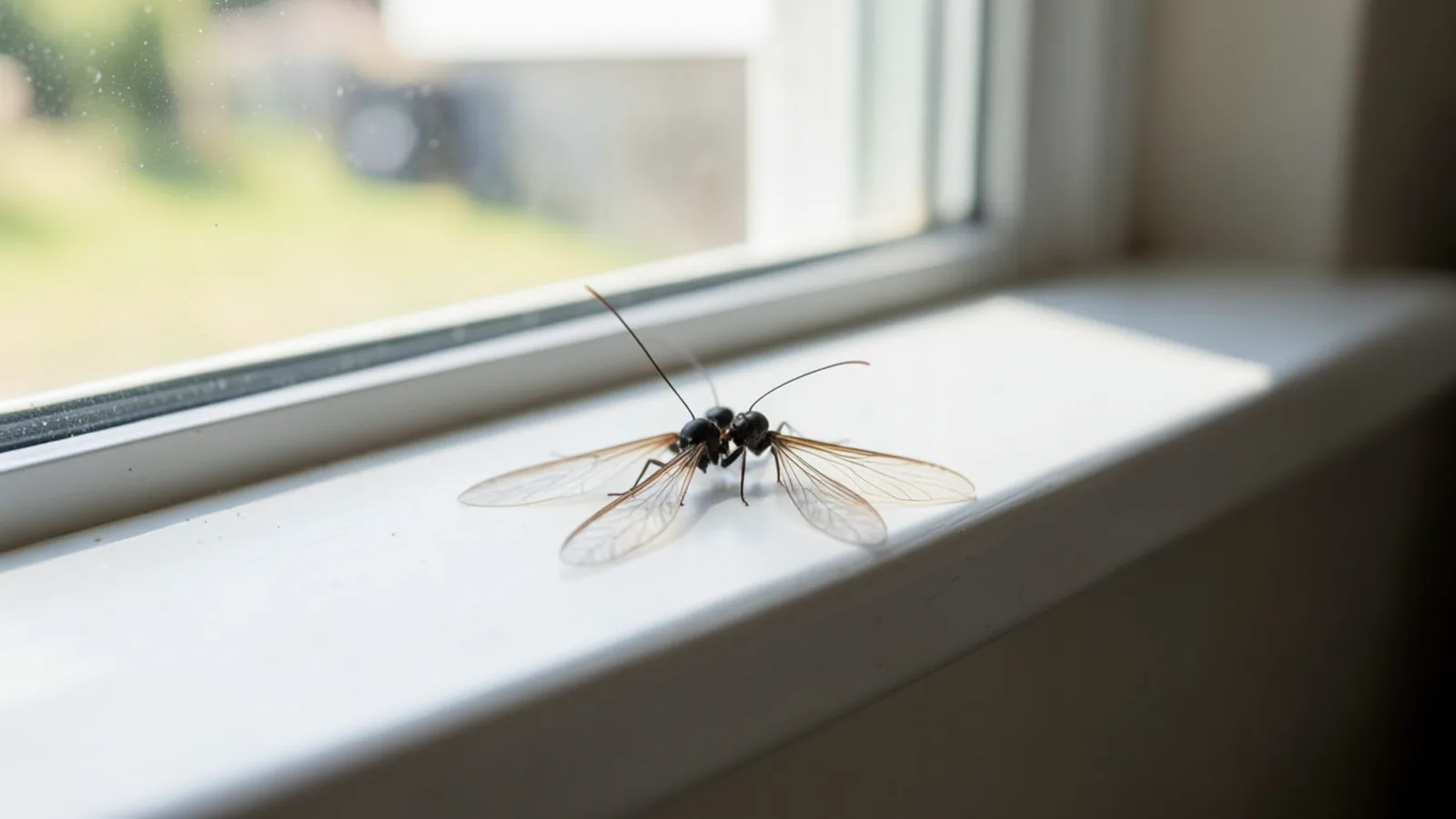
Seeing winged termite swarmers inside your Ruskin home is direct evidence of an active, mature colony within the structure or immediately below the foundation. Contain them by capturing a few specimens in a zip-top bag for technician identification, turning off unnecessary indoor lights, avoiding broad aerosol spraying (which scatters the colony), and calling (321) 496-4080 to schedule an on-site structural inspection.
- 01.What Winged Termite Swarmers Look Like (Termite vs Flying Ant)
- 02.Why Termites Swarm in South Hillsborough During Spring
- 03.Immediate Containment Steps: What to Do and What NOT to Do
- 04.Florida Contractor Insight: Why Aerosol Sprays Make Termite Damage Worse
- 05.What an On-Site Structural WDO Inspection Involves in a Slab Home
- 06.Treatment Pathways: In-Ground Bait Systems vs Liquid Barriers
What Winged Termite Swarmers Look Like (Termite vs Flying Ant)
In Florida spring weather, homeowners frequently mistake winged termite alates for harmless flying ants. Distinguishing between the two is vital because swarming termites indicate a structural infestation that requires immediate attention from an independent pest professional.
Termites possess two pairs of long, translucent wings of exactly equal length that break off easily, leaving piles of discarded wings on windowsills, sliding glass door tracks, and bathroom tile floors. Their bodies are straight-waisted without a pinched middle, and their antennae are completely straight and beaded.
In contrast, flying ants have a noticeably pinched "wasp" waist, elbowed (bent) antennae, and two pairs of wings where the front wings are significantly larger than the hind wings. Ant wings remain firmly attached to their thorax even after landing, whereas termite alates actively twist off their wings within minutes of flight.
Coloration provides an additional biological clue: native eastern subterranean swarmers are solid dark brown to jet black, invasive Formosan subterranean swarmers are pale yellowish-brown, and coastal drywood termite alates display a distinct reddish-brown head and dark brown abdomen.
Examining wing venation under a handheld magnifying glass provides conclusive proof. Subterranean termite wings display two thickened veins running parallel along the leading edge, while the rest of the wing membrane exhibits delicate, hair-like microscopic branching without cross-veins.
| Diagnostic Feature | Termite Swarmer (Alate) | Flying Ant (Swarm Form) |
|---|---|---|
| Waist Shape | Broad, straight waist with uniform width | Pinched, narrow pedicel (hourglass constriction) |
| Antennae Shape | Straight, beaded, thread-like filaments | Distinctly bent or elbowed at a 90-degree angle |
| Wing Proportions | Both forewings and hindwings identical length | Forewings significantly longer than hindwings |
| Wing Shedding | Wings shed rapidly upon landing (deciduous) | Wings remain permanently attached to the body |
| Flight Pattern | Weak, fluttering, short-range flights | Strong, sustained, targeted directional flight |
Finding Discarded Wings on Windowsills or Baseboards?
Connect directly with an independent termite specialist who understands South Hillsborough slab foundations and colony eradication.
Why Termites Swarm in South Hillsborough During Spring
Swarming is the reproductive dispersal flight of mature termite colonies. A colony typically requires three to five years of continuous subterranean feeding before it develops the population density necessary to produce alates. When conditions align, thousands of winged kings and queens take flight to establish new colonies.
In South Hillsborough County, native eastern subterranean termites (*Reticulitermes flavipes*) typically take flight from February through April on warm, humid afternoons following a spring rainstorm. Rising barometric pressure and moist topsoil signal to subterranean workers that conditions are optimal for alates to survive soil burrowing.
Invasive Formosan subterranean termites (*Coptotermes formosanus*) swarm slightly later in the season, from late April through June, typically on warm, calm evenings after sunset. Formosan alates are drawn aggressively to indoor lighting, glowing television screens, and exterior patio fixtures, frequently collecting in dozens around window screens.
A swarm outdoors in a distant pine stump or landscape timber may simply reflect natural woodland ecology. However, discovering dozens or hundreds of swarmers emerging from interior baseboards, electrical outlet plates, bathroom fixtures, or window trim inside your home confirms the parent colony is nesting directly beneath your concrete slab or within wall framing cavities.
In coastal developments such as Bahia Lakes, MiraBay, and Shell Point, sandy coastal soils dry rapidly in early spring. Termites exploit the consistent moisture retained beneath monolithic concrete slab foundations, using plumbing block-outs and bath traps as primary highway conduits into wall studs.
Immediate Containment Steps: What to Do and What NOT to Do
Discovering hundreds of winged insects fluttering toward living room windows or crawling across kitchen counters can provoke intense anxiety. Taking calm, methodical containment steps protects your living spaces while preserving essential physical evidence for the inspector.
Florida Contractor Insight: Why Aerosol Sprays Make Termite Damage Worse
The most common mistake Florida homeowners make when encountering a spring termite swarm is grabbing an over-the-counter can of flying insect spray. Understanding why this instinct backfires requires looking at termite colony communication and behavioral biology.
Subterranean termite colonies operate through constant chemical pheromone communication. When a homeowner discharges a pyrethroid aerosol spray across an emergence point, the repellent residue acts as an environmental hazard barrier. While the visible swarmers die, the subterranean workers and soldiers foraging inside structural studs detect the chemical irritant immediately.
Rather than dying, the foraging workers retreat down their mud galleries and seal off the treated area with mud and salivary secretions. The colony then bifurcates—redirecting its foraging tunnels toward untreated wall voids, ceiling joists, door casings, or adjacent bedrooms.
Professional termite remediation relies on non-repellent chemistries (such as fipronil or chlorantraniliprole) or slow-acting insect growth regulator bait matrixes. Because worker termites cannot detect these non-repellent compounds, they walk directly through treated soil or feed on bait stations, transferring the active ingredient back to the queen and royal court through social food sharing (trophallaxis), leading to complete colony collapse.
Dispatched pest operators utilize specialized injection tips to introduce non-repellent transfer agents directly into active galleries without alarming the wider subterranean network.
What an On-Site Structural WDO Inspection Involves in a Slab Home
Most homes in Ruskin, Apollo Beach, and Sun City Center are built on monolithic concrete slab foundations. A proper Wood-Destroying Organism (WDO) inspection on a slab residence involves a systematic structural audit of known subterranean entry conduits.
The inspector begins with an exterior perimeter sweep, examining the exposed concrete stem wall where stucco overlaps the slab edge. They check for hairline mud shelter tubes climbing the foundation, ground-to-wood soil contacts around patio steps, and unsealed AC refrigerant line penetrations.
Inside, the inspector uses acoustic sounding tools to test baseboards, window stools, and door headers for hollowed cellulose voids. Non-invasive electronic moisture meters scan drywall surrounding plumbing penetrations—especially behind master shower enclosures, toilet stubs, and kitchen sink cabinets—where subterranean termites frequently exploit concrete shrinkage gaps.
Homeowners receive a written inspection report documenting active infestations, past structural evidence, and conducive conditions (such as overflowing gutters discharging rainwater directly against foundation weep screeds).
Under Florida Administrative Code Rule 5E-14, the WDO report must explicitly list any inaccessible areas, such as enclosed soffits or fixed wall cabinetry, providing complete legal transparency for the property owner.
Treatment Pathways: In-Ground Bait Systems vs Liquid Barriers
Once an active subterranean termite infestation or high-risk property condition is confirmed, independent contractors recommend one of two primary defense methodologies based on structural construction and landscaping design.
In-Ground Bait Matrix Systems (such as Sentricon or Trelona) involve installing tamper-resistant monitoring stations into the turf every 10 to 12 feet around the property perimeter. Foraging subterranean termites discover the dense cellulose bait rods, consume the active insect growth regulator, and distribute it through the colony, halting the molting process and eliminating the queen. Bait systems are ideal for zero-lot-line properties, homes with extensive paver patios, and sites near sensitive water canals.
Continuous Liquid Chemical Soil Barriers involve trenching the exterior foundation perimeter and injecting a non-repellent termiticide into the soil to establish an uninterrupted treated zone. Slabs with attached garages, front porches, or concrete walkways require precision vertical drilling through the masonry to treat the underlying soil bed.
Property owners should evaluate site-specific factors when choosing between baiting and liquid barriers. Properties bordering coastal waterways often favor baiting systems because they eliminate termiticide runoff risks during heavy seasonal thunderstorms.
Ruskin Termite Swarmer Questions & Answers
No. Termite alates have no stingers and their weak mouthparts are incapable of biting humans or domestic animals. Their sole biological purpose is to fly, mate, shed their wings, and attempt to establish a new subterranean colony in damp soil.
- Subterranean Termites in Florida — University of Florida IFAS Extension
- Termite Identification and Biology — FDACS Bureau of Inspection